
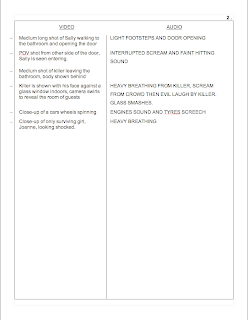

This is our treatment, this explains what will happen in our film and is used to create our storyboard and film;
Treatment
Last Woman Standing
There are 5 16/18 year olds (Steph, Sally, Joanne, Brett & Roger) having a drink and get-together at one of their houses, drinking, watching films, darts and other such shenanigans. The house has several cars on the drive, representing the people inside. Shaky POV cam goes past the windows with heavy breathing, climbs through window in a vacant room, see him go through a door. One girl (Sally) leaves the group to go to the toilet, opens the door and the cam switches to the POV of the man crouched on the floor looking up at the girl. The man is then seen opening the door and leaving the toilet, he has scary make-up/mask and behind him, before he shuts the door, there is the girl lying dead covered in blood. He then begins to size up the rest of the housemates. The killer is revealed to the group and scares them to death before leaving, having appeared to massacre them all. One highly incapacitated girl does not follow suit, having hidden in a room, and she begins to realize what has happened, however the killer has got away in one of the cars that was on the drive.
The Film- The rest of the film consists of a typical slasher, however, the last girl decides that their only chance is to act vengeance upon her assailant. However, this becomes harder for them when they realize it is her during an attack they perform on the killer. A struggle ensues as they ponder whether to kill someone who used to be their friend. They decide to escape and inform the police, where Joanne follows but is killed in a freak accident.

Final Cut Pro allows you to set separate video and audio In and Out points. These edits are known as split edits. Split edits are useful for conversation scenes, where the video and audio of two actors overlap. You can also use split edits to introduce the sound of a new scene before cutting to the video.
For example: You are editing a sequence in which a man and a woman are talking to each other. It’s common during a conversation scene to cut to the video of one person listening while the audio from the other person continues. You use a split edit to achieve this effect. This is how you would achieve the effect:
Cut to the video and audio of the man talking.
In the middle of the man talking, overwrite the video of the man talking with the video of the woman listening, while the audio of the man talking continues.
Once the man finishes talking, cut to the audio of the woman, now talking.
The resulting edit would look something like this:

Split edits can be used in many different situations—in dialogue scenes, like the one described above, when cutting to illustrative B-roll footage during an interview, or when transitioning from one scene to another.
Thrillers often take place wholly or partly in exotic settings such as foreign cities, deserts, polar regions, or high seas. The heroes in most thrillers are frequently "hard men" accustomed to danger: law enforcement officers, spies, soldiers, seamen or aviators. However, they may also be ordinary citizens drawn into danger by accident. While such heroes have traditionally been men, women lead characters have become increasingly common; for an early example see Sigourney Weaver's character Ripley, in the movie Alien, 1979.
Thrillers often overlap with mystery stories, but are distinguished by the structure of their plots. In a thriller, the hero must thwart the plans of an enemy, rather than uncover a crime that has already happened; while a murder mys would be spoiled by a premature disclosure of the murderer's identity, in a thriller the identity of a murderer or other villain is typically known all along. Thrillers also occur on a much grander scale: the crimes that must be prevented are serial or mass murder, terrorism, assassination, or the overthrow of governments. Jeopardy and violent confrontations are standard plot elements. While a mystery climaxes when the mystery is solved, a thriller climaxes when the hero finally defeats the villain, saving his own life and often the lives of others. In thrillers influenced by film noir and tragedy, the compromised hero is often killed in the process.
In recent years, when thrillers have been increasingly influenced by horror or psychological-horror exposure in pop culture, an ominous or monstrous element has become common to heighten tension. The monster could be anything, even an inferior physical force made superior only by their intellect, a supernatural entity, aliens, serial killers, or even microbes or chemical agents. Some authors have made their mark by incorporating all of these elements (Richard Laymon, F. Paul Wilson) throughout their bodies of work.
Similar distinctions separate the thriller from other overlapping genres: adventure, spy, legal, war, maritime fiction, and so on. Thrillers are defined not by their subject matter but by their approach to it. Many thrillers involve spies and espionage, but not all spy stories are thrillers. The spy novels of John le Carre, for example, explicitly and intentionally reject the conventions of the thriller. Conversely, many thrillers cross over to genres that traditionally have had few or no thriller elements. Alistair Maclean, Hammond Innes, and Brian Callison are best known for their thrillers, but are also accomplished writers of man-against-nature sea stories.
Thrillers may be defined by the primary mood that they elicit: fearful excitement. In short, if it "thrills", it is a thriller. Below is a list of thrillers already made;
- Scream
- Hitman
- The Usual Suspects
- Die Hard
- The Silence of The Lambs
